-
The Night the Valley Fell Silent: January 1990-91 – Remembered
More than three decades after Kashmiri Pandits were forced from the Valley in the winter of 1990, the story of the exodus, the long silence that followed, and a new generation choosing to remember.
16/07/2026 By Masha TokasThere is a particular kind of cold that has nothing to do with temperature. Survivors describe it the same way, 30-odd years and thousands of miles apart in Jammu tenements, in Delhi flats, in living rooms of Birmingham and Southall. It is the cold of a loudspeaker cutting through the night, calling out names, calling out a community, telling them there were only three ways this would end.
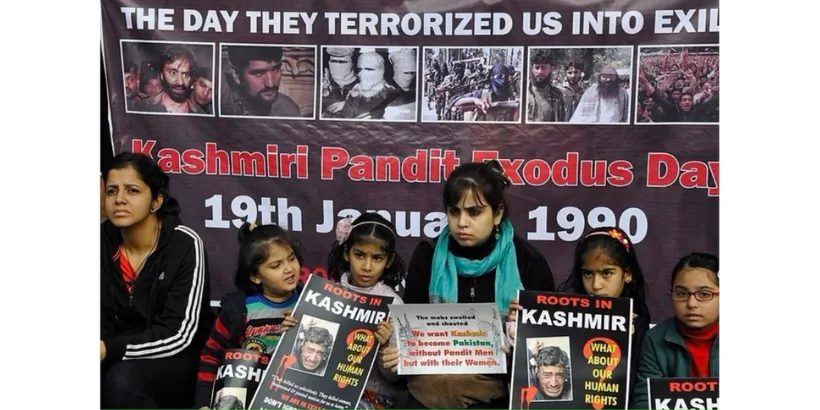
That night has a date attached to it now. 19 January 1990 is the one etched into memory, marking the killings, threats, and forced departures that defined the exodus stretched on through 1990, into 1991 and beyond. But it isn't really about a single date. It's about what that night represented: the moment an entire community understood, with total clarity, that the place their families had called home for millennia had decided it no longer wanted them in it.
What Actually Happened
By the time the insurgency in Jammu and Kashmir escalated in the late 1980s, Kashmiri Pandits - the Hindu minority of the valley, custodians of a syncretic tradition stretching back through Kalhana's Rajatarangini and beyond had already begun to feel the walls closing in. Selective assassinations of prominent Pandits began before the mass exodus: judges, teachers, a well-known scholar, ordinary men targeted specifically because of who they were. Then came the loudspeaker announcements from mosques across Srinagar, the graffiti, the threats slid under doors, the warnings that Pandit women should understand what awaited them if they stayed.
Estimates of the number of Pandits displaced in this period range from roughly 100,000 to as high as several hundred thousand, depending on the source and the years counted but the number that matters most to survivors isn't in any of the tallies. It's the number of mornings they woke up in someone else's house, in a refugee camp with a tin roof, in a one-room tenement that would become "temporary" housing for a decade or three. Families who had owned orchards, shrines, ancestral homes with three generations under one roof left with a suitcase and whatever gold could be sewn into a hem. Many never went back. Many never will.
This is the part historians will keep arguing about the precise mechanics of intent, the exact death toll, whether "genocide" is the technically correct legal term or whether "ethnic cleansing" or "forced displacement" better fits the historical record. That argument matters, and a serious reader should know it's ongoing. But for the people who lived it, the argument over terminology has always felt beside the point. They know what it felt like to be told, explicitly, that their kind were no longer welcome and to watch it happen anyway, in daylight, with authorities either unable or unwilling to stop it.
The 30-year Silence
Here is the stranger, quieter tragedy: for most of the 3 decades, almost nobody outside the community was telling this story at all.
Ask someone in their 20s today in Delhi, in Mumbai, in London what happened to the Kashmiri Pandits, and there's a real chance you'll get a blank look. Not because the story isn't extraordinary. Because it was, for a generation, almost entirely absent from the places young people learn history: school textbooks that skated past it in a sentence or two, English-language newspapers that treated Kashmir almost exclusively as a story about territory and diplomacy rather than about the people forced out of it, mainstream cinema that found a hundred other Kashmir stories to tell before this one.
There are real reasons this happened competing national narratives, geopolitical sensitivities, a media ecosystem that often found the story of a fleeing Hindu minority awkward to fit into either its preferred frame of secular harmony or its preferred frame of Kashmiri victimhood. Whatever the mix of causes, the effect was the same: an entire generation grew up without the vocabulary to even locate January 1990 on a timeline, let alone understand what it cost.
For the survivors themselves, that silence was its own wound. Being displaced is one kind of loss. Watching your displacement disappear from the national conversation being spoken about only in passing, if at all, while your children grow up in a country that barely registers what your family survived is another kind entirely.
What Changed?
Something shifted in the last decade, and it's worth naming plainly because it didn't happen by accident. Films reached mainstream audiences and, for the first time for many viewers, put faces and names to what had been an abstraction. Memoirs and oral histories, painstakingly assembled by survivors and researchers, gave the story its specificity back this family, this street, this house, this name.
Parliamentary debate picked it up. International diaspora communities in the UK, the US, Canada began organising public commemorations that reached audiences who had genuinely never encountered this history before. Slowly, unevenly, but unmistakably, the story moved from the margins toward the centre of how modern Kashmir is understood and discussed.
This matters beyond nostalgia or vindication. Recognition is not the same as justice no senior figure has ever been convicted for the killings that triggered the exodus, and no truth commission has ever formally examined the events with the authority to compel accountability. But recognition is not nothing, either. For a generation of Pandits who spent 30-years being spoken about rather than spoken to, simply being heard finally, publicly, on their own terms is its own form of repair.
What Kashmiriyat Actually Meant
If the exodus was defined by silence, the response to it, over time, has been organisation. Long before the Indian film industry or Parliament caught up, the community itself did the patient work of building institutions to carry its case abroad. The Kashmiri Overseas Association began mobilising support for displaced families as early as the 1990s, and its work fed into the Kashmir Task Force under the National Federation of Indian Associations, which briefed members of the US Congress and led delegations into the migrant camps in Jammu. Decades later, the Global Kashmiri Pandit Diaspora (GKPD), launched in 2018 under Dr K.L. Chowdhary, drew volunteers together from California to London to Auckland to Brisbane under one banner, meeting lawmakers across the US, UK, Australia, Germany, New Zealand and Canada so that elected officials could no longer plead ignorance of what had happened.
That patient, unglamorous lobbying eventually met a cultural moment. GKPD's founder briefed members of the US Congress directly on the killings and the forced displacement, groundwork that helped set the stage for Congressman Andy Barr's 2021 Capitol Hill reception for Vivek Agnihotri and Pallavi Joshi, the director and producer behind the historic film on the exodus – 'The Kashmir Files'. When the film reached Indian cinemas in 2022, it did more in a single release than 3 decades of newspaper columns had managed: it turned a private grief into a very public national argument, pulling in viewers who had never before had reason to sit with what the word 'exodus' actually meant for a single Kashmiri family.
None of this amounts to justice in any legal sense, the demands for a tribunal, for formal recognition, for an eventual return remain largely unmet. But it demonstrates something that matters just as much: a community's cultural identity, when deliberately organised and carried forward rather than left to erode on its own, becomes a form of resistance in itself. Language classes, diaspora associations, oral history archives, annual commemorations, none of this is nostalgia. It is the infrastructure by which a scattered community of people keep its claim to a homeland alive across borders and across generations.
For Those Who Are Still Standing
For the generation now coming of age, none of this is memory, it's inheritance. Most Gen Z Kashmiri Pandits have never picked walnuts from a family orchard, never sat in a Rainawari courtyard, never breathed the particular cold of a Srinagar winter. What they have is what was told to them, and what was told to them has proven enough to keep the identity alive even without the land itself. Actor Vedang Raina, whose grandparents left Kashmir before he was born, has spoken about growing up on nothing but his parents' stories before finally visiting Srinagar as an adult, where they showed him, place by place, exactly what the family had lost, including a house near Dal Lake that no longer belongs to them. Asked after the 2025 Pahalgam attack whether the violence would keep him away, he said simply that he wouldn't let a handful of cowards scare him off - Kashmir, he said, remains paradise regardless.
Journalist Aditya Raj Kaul carries the exodus in an even more literal sense: he was 9-months old when it happened, too young to remember it, and yet he has spent much of his career narrating it anyway in television interviews, in TEDx talks, in the founding of Roots in Kashmir, a youth initiative built specifically to keep the community's memory organised rather than scattered. The story, as his parents told it to him and as he has since told it to audiences across the world, begins on the evening of 19 January 1990, when a nearby mosque announced that Hindu men should leave the valley by morning, without their women. His father still keeps the bus tickets bought that night. The family of roughly a dozen relatives fled to Jammu and spent their first months there crowded into a single garage. From an ancestral home that once held some 10,000 books and had hosted Rabindranath Tagore as a guest, his parents chose to carry out only their educational certificates and a small household deity education and faith, the two things they judged worth saving when everything else had to be left behind. Kaul has called this his identity as a 'homeless journalist,' and has made the case, again and again, that repeating the story precisely and without embellishment is itself a form of justice owed to a community that spent thirty years being disbelieved.
Comedian Samay Raina has told an even sharper version of the same inheritance. His grandfather, a well-known village doctor, was named on a hit list; the family fled overnight after a warning letter arrived, his mother and grandmother fainting from the shock while one aunt kept her composure and got everyone out safely. In his special Still Alive, Raina turned that history into an argument rather than an elegy, that leaving an unequal fight rather than dying in it was never cowardice but survival, and that every Kashmiri Pandit alive today, wherever they've rebuilt their lives since, is proof the calculation was right. It is a version of pride that doesn't need the land underfoot to make its case.
This is what cultural identity retrieval actually looks like for a community that cannot yet go home: not reclaiming the orchard itself, but making sure the story of the orchard survives intact enough to be told with precision, pride, and anger in equal measure. Every actor who names his heritage in an interview, every comedian who turns his grandfather's hit list into an argument for survival, every young Pandit who visits Srinagar for the first time and comes back having learned the family's real address, these are small, deliberate acts of reconstruction. A homeland that cannot yet be returned to can still be carried, provided each generation keeps choosing, on purpose, not to let it go.
Om Shanti. Never forgotten. Never erased.