-
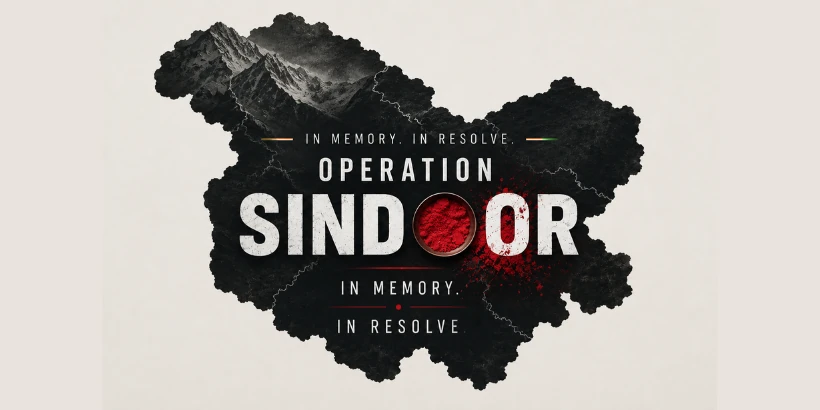
Operation Sindoor: In Memory, In Resolve
09/05/2026 By Youti — Sara Saxena & Narayani Meghna VaranasiEarlier today India's Armed forces reiterated their resolve to defend itself against cross border terrorism as we commemorate the first anniversary of Operation Sindoor. Many leaders and institutions echoed this sentiment. One year on, we look back on the conflict that changed the idea of warfare for the region.
The Tragedy
On 22 April 2025, seven terrorists dressed in military-style uniforms entered the Baisaran Valley meadow near Pahalgam in Jammu and Kashmir. Armed with advanced weaponry, the attackers reportedly blocked entry and exit points before targeting civilians. They separated non-Muslim men from the crowd by asking them at gunpoint to recite the "kalima", and killed 25 of them when they could not comply.
What began as a peaceful tourist outing in the Pahalgam valley quickly turned into one of the deadliest terror incidents in the region in recent years. Survivors left not only with grief, but with trauma that would linger long after the attack itself. Across India, the incident triggered shock, anger, and mourning.
The responsibility of the attack was at the outset claimed by The Resistance Front (TRF), a terrorist group believed with connections to Lashkar-e-Taiba (LeT). TRF rescinded their claim 3 days after the attack. Indian authorities subsequently identified four of the attackers, alleging connections to LeT and tracing operational support to launchpads in Karachi and Muzaffarabad. The National Investigation Agency (NIA) further stated that the attackers had operated under the direction of personnel linked to Pakistan's Inter-Services Intelligence (ISI).
India's Foreign Secretary, Vikram Misri, stated that the objective of the attack was to provoke communal unrest and undermine the growing tourism economy in Kashmir. Following the abrogation of Article 370 and a significant improvement in security conditions, tourism had begun returning to the valley, contributing to local economic activity and stability. This stability could reduce the economic vulnerability that incentivizes locals to cooperate with channels inciting violence in J&K, making it harder for terror agents to operate as usual.
India responded swiftly through diplomatic and political measures. Border crossings with Pakistan were shut, visas were suspended, and Pakistani diplomats were asked to leave the country. The biggest diplomatic and strategic measure though, was the suspension of the Indus Water Treaty. The treaty ensured that about 80% of the water of the Indus River flowed into Pakistan, becoming key to Pakistani agriculture in the Punjab region. Suspension of the treaty put a strain on Pakistan's water resources long term. The treaty stands suspended even today.
Operation Sindoor and the Escalation
Retribution began in earnest on 7th May, 2025. The Indian Armed forces launched measured and targeted air strikes on nine sites across Pakistan Occupied Jammu and Kashmir. The sites were selected to avoid any civil damage and the armed forces exercised restraint to ensure only terrorist targets were neutralized. The strikes were conducted solely to weaken the terror infrastructure across the borders to ensure that there were no recurrences of the tragedies of the Pahalgam attack, as stated by Indian officials.
On 8th May, Pakistan launched a coordinated drone and missile attack targeting several Indian cities, including Amritsar and Jammu. Indian air defence systems intercepted multiple incoming threats with reports suggesting dozens of locations across northern and western India were placed on alert.
International media was quick to term this the "first drone war" between the nuclear-armed neighbors of South Asia, a label that, however dramatic, was not entirely inaccurate.
India's retaliation was swift and surgical. Radar installations in Lahore and Gujranwala were destroyed, and a Pakistani army post along the Line of Control was neutralized. By 9 May, India had repositioned major naval assets, including aircraft carriers, destroyers, and anti-submarine warfare vessels, into the northern Arabian Sea within operational range of Karachi. The message was unambiguous. In the span of 88 hours, India accused Pakistan of launching drone or missile attacks on three separate occasions. The patience of measured restraint had a limit.
On 10 May, India conducted precision strikes on several Pakistani military installations, including the Nur Khan Air Base. Additional targets reportedly included facilities in Sukkur, Chunian, Pasrur, Sialkot, Skardu, Sargodha, Jacobabad, and Bholari. These were not symbolic strikes. These were coordinated, intelligence-backed hits on identified military targets, the kind that change the calculus of a conflict.
Pakistan's Director General of Military Operations called the Indian DGMO shortly after. It was agreed that both sides would cease all firing and military action, on land, air, and sea, with effect from 1700 hours IST on the 10th of May, 2025. The official line was a ceasefire born of mutual agreement. The unofficial reading was simpler: the damage had been done, and Pakistan blinked first.
The Technology That Delivered It
Operation Sindoor also marked a significant moment for India's indigenous defence ecosystem. Several domestically developed systems were deployed during the conflict, including the Akash surface-to-air missile system, BrahMos cruise missiles, SWATHI weapon-locating radars, Pinaka multi-barrel rocket launchers, and the LCA Tejas fighter aircraft. India's Integrated Command and Control Strategy (ICCS) enabled simultaneous threat detection and response across multiple operational domains.
Legacy systems such as the Pechora and OSA-AK were integrated into layered air defence networks alongside newer platforms. From shoulder-fired MANPADS and low-level air defence guns to long-range SAMs, the full spectrum of India's air defence architecture was tested and held. Notably, the Russia-made S-400 missile system saw its first operational use on the night of the 7th and 8th, when Pakistan launched its initial drone assault on Adampur Air Force Station.
Recovered debris and intelligence assessments suggested the use of Chinese-origin PL-15 missiles, Turkish-origin UAVs, and commercially modified drones during the conflict, highlighting the increasingly international character of regional warfare. Pakistan had not fought this war alone.
Alongside the physical conflict ran a parallel information war. Pakistani-based accounts were found to be running coordinated manipulation campaigns, many of which came under scrutiny from international social media platforms. Hate speech surged online, disproportionately targeting women. India defended digital assets from about 1.5 million cyber intrusions. Social media platforms were flooded with misinformation, manipulated narratives, and coordinated influence campaigns, demonstrating how digital warfare had become deeply intertwined with conventional military operations.
India also launched a diplomatic outreach effort, dispatching political and strategic delegations to partner nations to present its account of the conflict and the events leading up to it.
The Implications
Operation Sindoor marked a significant shift in India's strategic posture toward cross-border terrorism. The operation demonstrated India's willingness to combine diplomatic pressure, military force, cyber defence, and information strategy within a coordinated national response.
The conflict also highlighted the growing maturity of India's domestic defence manufacturing ecosystem. Increased international interest in systems such as Akash and BrahMos contributed to a rise in defence exports during FY 2025–26, reinforcing the government's broader push toward defence self-reliance.
One year later, Operation Sindoor remains more than a military operation in public memory. For many in India, it became a symbol of deterrence, resilience, a symbol of bravery and a testament to India's sustained efforts against terrorism.