-
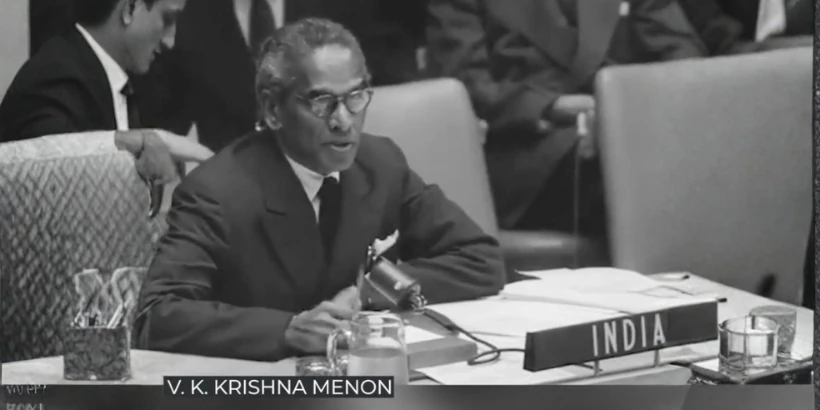
V. K. Krishna Menon's Stance on Jammu & Kashmir at the United Nations
05/05/2026 By Youti — Arnav Joshi & Rajwardhan RanaBackground: Menon in Indian Politics & at the UN
V.K. Krishna Menon, who served as Indian Defence Minister (1957–62), was appointed as leader of the Indian diplomatic mission to the UN in 1953. In his stunning diplomatic career at the UN, Menon successfully articulated Nehru's foreign policy on significant international issues, thus gaining the title 'Formula Menon.' Though a close confidant of Nehru with remarkable oratory skills, Menon did not remain immune to failures and controversies, especially in his role as Defence Minister leading up to the 1962 war with China. In his role at the UN, Krishna Menon gave an unforgettable speech representing the Indian position on the Jammu & Kashmir question in January 1957, hailed as "one of the longest and profoundest of the speeches" (Choube, 1964, p. 114). Though the speech hardly helped resolve the Jammu & Kashmir problem, it raised India's diplomatic stature at the UN as a non-western, autonomous power which aligned with India's strategic doctrine of non-alignment under Nehru.
Kashmir: The Indian Perspective
In October 1956, the Jammu & Kashmir Constituent Assembly resolved Jammu & Kashmir as an integral part of India in the state Constitution, which was to come into force in late January 1957. Pakistan appealed to the UN to intervene against this decision as it did not align with their motives, laying the ground for Menon's historic speech on 23–24 January 1957. The speech clearly stated that India sought help from the UN about the Jammu & Kashmir "situation" and not "dispute", as if it were a bilateral dispute, the UN would have no role to play (S/.1100, annex 28 para 1). When reframed in these terms, it is evident that Jammu & Kashmir is not disputed territory, but one belonging to India which has been attacked and forcibly occupied (till date) by another state, namely Pakistan.
To do away with false narratives surrounding the situation, it is imperative to comprehend the process of accession of princely states to either India or Pakistan at the time of partition. On July 25, 1947, in the Chamber of Princes, Lord Mountbatten instructed that the rulers of the princely states were "at liberty to link up with either of the Dominions (India or Pakistan)," provided it favoured their geographical contiguity (S/pv.762/Add.1, annex IV, document No.3). The decision to accede, thus, was solely left to the ruler. As per Menon, Pakistan assumed that since Jammu & Kashmir was a Muslim majority state, it would naturally merge with Pakistan — claims unsupported by documentary evidence. This demonstrates how religion was quietly associated with a decision that was to be solely based on the will of a ruler and geographical contiguity of a princely state with either of the dominions.
The speech noted a fundamental difference between the Standstill Agreements that the princely state enacted with India and Pakistan, whereby Pakistan's agreement only constituted matters of "communications, supplies, and post office and telegraphic arrangements" (229th meeting, p. 101). Whereas the wider scope of the Standstill Agreement with India can be interpreted to include the "external affairs (and) control of State forces" of Jammu & Kashmir (Menon, 1957/1992, p. 30). Finally, as Menon pointed out, the Standstill Agreements were interrupted by none other than Pakistani aggression.
Menon has vividly and chronologically articulated this aggression, qualifying it as more than a tribal raid, highlighting the fact that the invasion was, in fact, resisted by the locals, who did not subscribe to the notion of liberation being brought to them by the invaders. He also noted that the ruler of Jammu & Kashmir, Maharaja Hari Singh, was free to accede to any dominion of his choosing, but willingly contacted India for help on the backdrop of Pakistani invasion. It has also been proved that Pakistan tried to intimidate the Maharaja into acceding by coercion through economic blockade before escalating to a full-scale invasion, which clarifies the desperation and direct involvement of Pakistani political leadership to grab Jammu & Kashmir. Furthermore, Menon proves this involvement in the recruitment of tribal raiders for the attack following from Jinnah's and other British officers' statements, a blatant violation of international law. The raiders ransacked several cities in Jammu & Kashmir murdering their populations, inflicting horrors on women, due to which Menon dubbed them "enslaved Kashmir forces" as opposed to their claim of being Azad (free) Kashmir forces (Menon, 1957/1992, p. 43). Thus, Menon categorically erased the framing of the Jammu & Kashmir situation as a dispute, reiterating that India sought support from the UN against Pakistani aggression, which was contradictory to the UN ideals of peace and international security. Undoubtedly, India went to the UN to address such aggression — not to debate the legitimacy of accession of Jammu & Kashmir with India.
Moving Forward: Addressing Pakistani 'Aggression'
The Jammu & Kashmir issue is the biggest bone of contention in India–Pakistan bilateral ties even today; however, Pakistan has benefitted by its internationalisation, giving communal undertones to an aggression, trying to portray Jammu & Kashmir as an international territorial dispute. While India maintains that the state is its integral part following the Instrument of Accession signed by the ruler on October 26, 1947, Pakistani troops still occupy parts of the state, known as Pakistan-occupied Jammu & Kashmir, despite best diplomatic efforts at the UN. India is accused of not having held a plebiscite in Jammu & Kashmir, while the UNSC Resolution of 1948 (S/726) clearly states that any action about the plebiscite can only be taken after Pakistani troops are completely removed from the occupied territory, a condition which the other side never complied with. Framing the issue through a communal lens, Pakistan continues to influence the region's religious demographics in their favour by terrorist actions in the state, amounting to instances like the exodus of Kashmiri Pandits in 1990. To sum up, only reframing the Jammu & Kashmir question as what it really is — in Menon's words, an 'aggression against sovereign Indian territory' — is a meaningful first step towards its resolution on a bilateral and international scale.
ReferencesChoube, S. K. (1964). Krishna Menon in the United Nations. The Indian Journal of Political Science, 25(3/4), 101–116. http://www.jstor.org/stable/41854021
Menon, V. K. K. (1992). Krishna Menon on Kashmir: Selected speeches at the United Nations – II (E. S. Reddy & A. K. Damodaran, Eds.). Sanchar Publishing House. (Original speeches delivered 1957). https://www.geocities.ws/enugareddy/krishnamenon/Krishna_Menon_on_Kashmir_-_I_-_January_1957.pdf